Planet Nine Discovery: The Hidden World Beyond Neptune
There’s a dark frontier where sunlight forgets how to shine and is just out of reach and the known gives way to shadows.
Somewhere out there…silent, glacial, invisible to our eyes but felt in the trembling math of orbiting ice…we may have just found another planet!
I’ve long been obsessed with the stars and space, and even though my days of becoming an astronaut are behind me (gave up on that about two decades ago), I still feel the pull to study learn and explore space. Just maybe from the comfort of my home. When I saw another possible planet was spotted, I needed to find more.
Not a gas giant like Jupiter or a rebel like Pluto (yeah, yeah, I know Pluto isn’t a planet anymore).
But a ninth world, hiding behind Neptune’s curtain, haunting the Kuiper Belt like a ghost of gravity.
They call it Planet Nine, and it may be the loneliest planet in our solar system.
Astronomy isn’t always about what we can see, sometimes it’s about what’s missing. Our eyes can’t really pick up everything out there so we needed to get creative. Sometimes things move when it shouldn’t or drifts when it’s supposed to hold steady. Those are some of our big clues as to what’s out there when we can’t see it.
That’s how Planet Nine first made its entrance, not with a telescope, but with a disturbance.
In 2016, two astronomers (Konstantin Batygin and Mike Brown of Caltech) noticed something very odd.
A group of icy objects in the far-flung Kuiper Belt were all tilted in the same direction. Their orbits were elongated and clustered as if something enormous were pulling them from the shadows.
Something…they couldn’t see. The math whispered the possibility that a massive, undiscovered planet…5 to 10 times the mass of Earth is lurking in the outer darkness.
Since then, the hunt has intensified, and now, in 2025, rumors have grown louder.
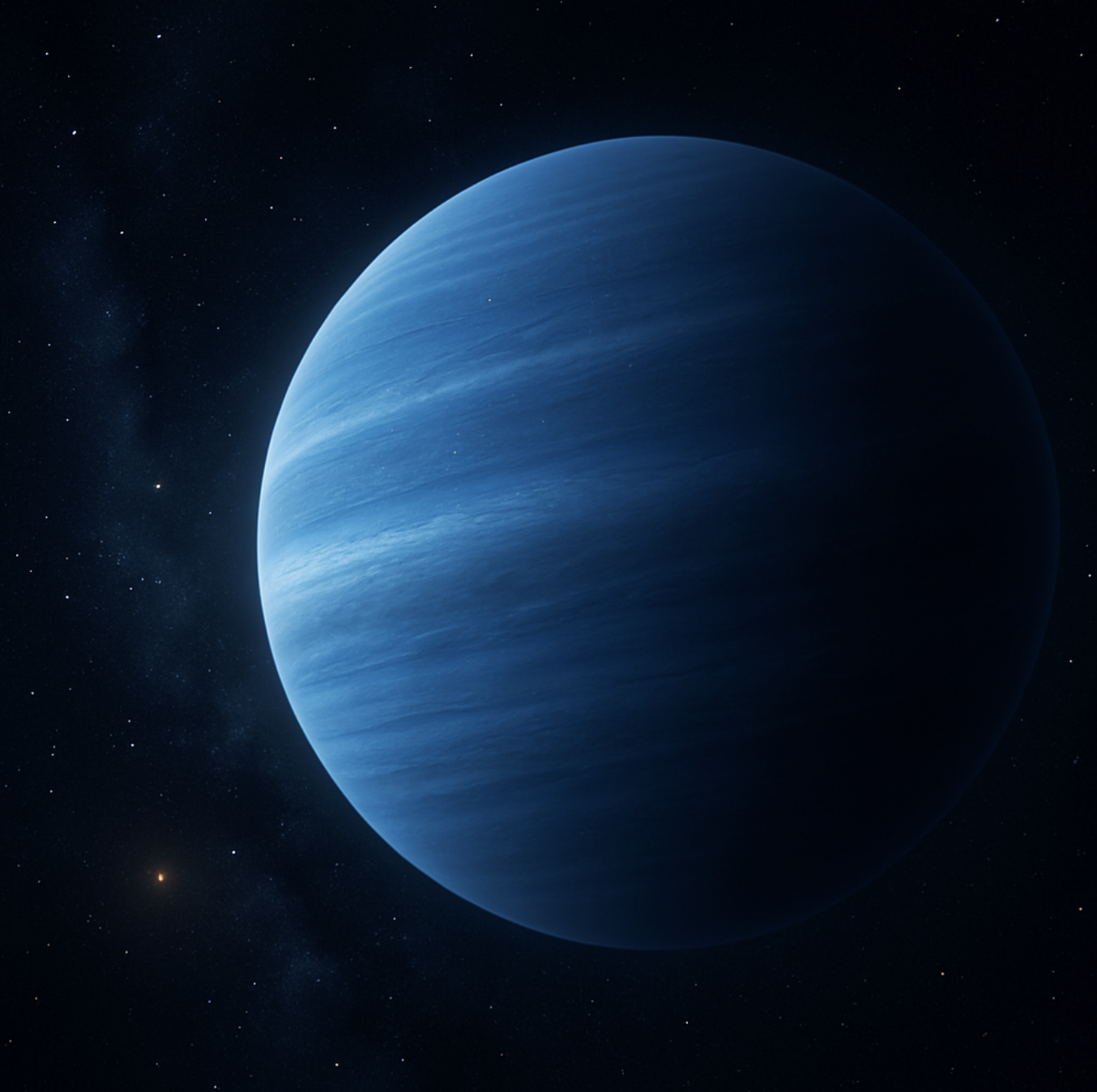
Did We Finally Spot It?
The buzz began again last week. A post from @mindset.therapy ignited public curiosity:
“Scientists say they’ve officially spotted a ninth planet in our solar system.”
Could it be real, is Planet Nine no longer just a ghost of equations?
Recent infrared scans from space-based telescopes, including data from Pan-STARRS, Subaru, and James Webb, have given us tantalizing leads. A new object that’s slow, cold, and distant is showing the kind of movement consistent with Planet Nine predictions.
If verified, this will be the first time we’ve directly spotted the most elusive member of our planetary family.
But don’t expect a crisp NASA photo yet. It’s far…like really far.
If Earth were the size of a marble, and Neptune a baseball floating about 30 feet away, then Planet Nine would be hundreds of feet beyond, in a dark parking lot, almost lost in the night. We think its orbit stretches 400 to 800 AU (astronomical units), meaning it could be 20 times farther than Neptune. One orbit could take 10,000 to 20,000 years to complete!
It doesn’t shine and the damn thing reflects almost nothing, and its frigid surface may be -200°C or colder. Finding it is like trying to spot a speck of coal drifting through a snowstorm…in the next town over.
Why We’re So Sure It’s There
If we can’t see it clearly yet, why are scientists so confident?
Because its gravitational fingerprint is everywhere, now dozens of trans-Neptunian objects (TNOs) are drifting in unexpected, matching patterns. Some objects are tilted 90 degrees, orbiting perpendicular to the rest of the solar system, something only a massive hidden planet could cause. The orbits of Sedna, Eris, and other icy bodies suggest an outside force, guiding them like a puppeteer.
Mathematical models match the idea of a planet between 5–10 Earth masses, enough to tug on the edges of everything.
It’s not proof, but it’s possibly more than coincidence.
This isn’t our first planetary identity crisis (that’s not a sentence I thought I’d write today to be honest). We’ve rewritten our solar system more than once. In 1846, Neptune was discovered thanks to mathematical predictions, not direct observation, just like Planet Nine. In 1930, Pluto was added as the ninth planet, only to be demoted in 2006 to a “dwarf planet.” I still consider Pluto a planet in my heart and soul because I love it…and I guess I don’t handle change as well as I’d like to think. In between, astronomers found Ceres, Eris, and a handful of other icy bodies, blurring the line between planet and pebble.
But Planet Nine would be a return to form, a real planet…not a demotion or a reclassification, but a genuine discovery of a missing sibling in our solar family.
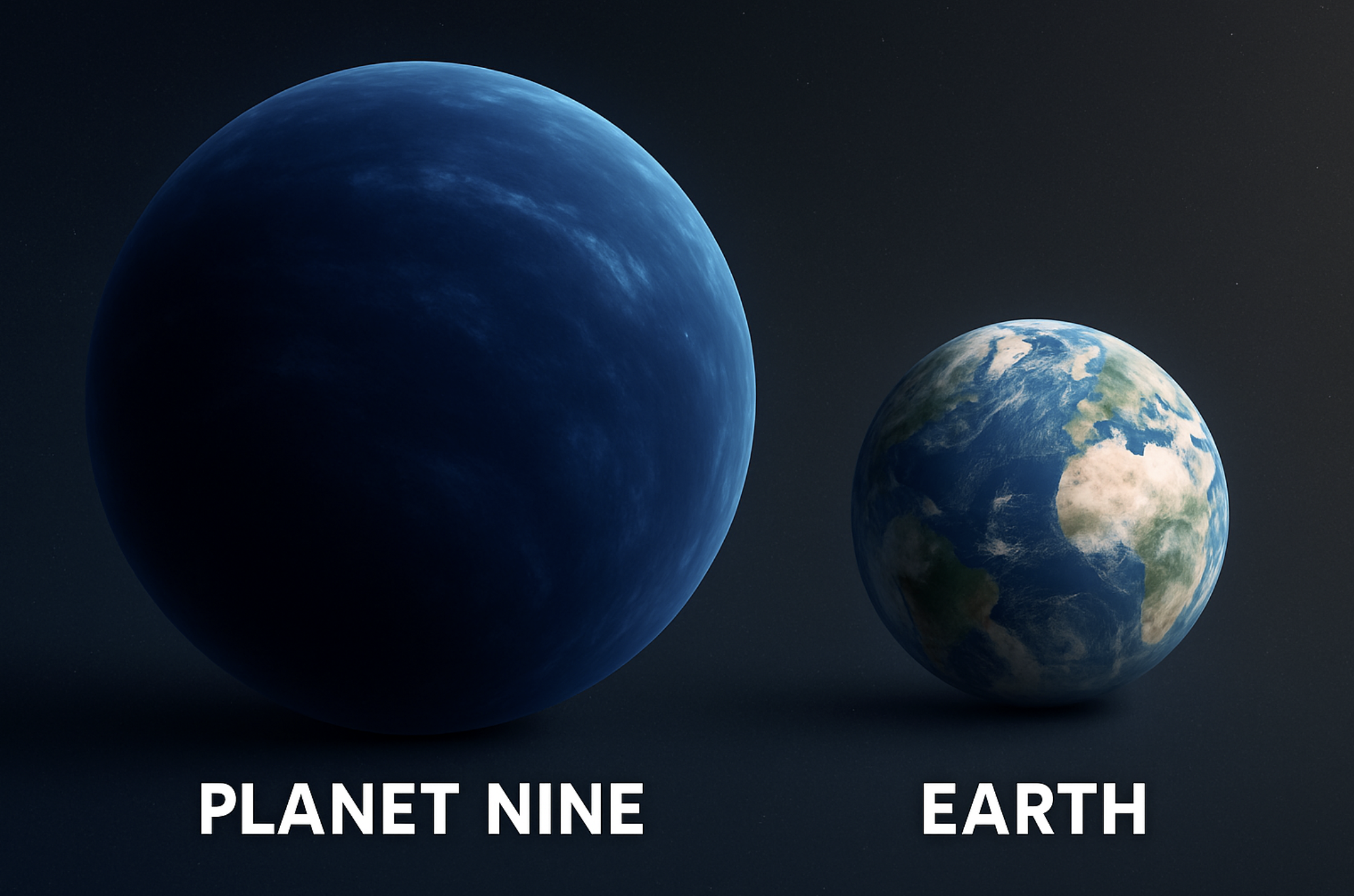
What Would Planet Nine Look Like?
Let your imagination wander.
Planet Nine could be a rocky super-Earth with a thick atmosphere of hydrogen and helium, orr a mini-Neptune, a frozen gas giant with layers of ice and slush, possibly ringed, like a quiet Saturn lost in exile, maybe even hosting moons, orbiting it in silent devotion across millennia.
Because of its distance, it won’t reflect much sunlight, so we really don’t know.
In infrared, it might glow faintly…a dim ember of planetary heat, radiating the last warmth from its core.
We might never see its mountains or storms, but we’ll feel its presence in the mathematics.
In the classic sense, life is super unlikely to be on Planet Nine. Temperatures out there are bone-shattering, but like literally. There’s no sunlight, no known liquid water, no cozy greenhouse effect.
And it would really only be possible if Planet Nine has internal heating, like Europa or Enceladus or it has subsurface oceans, locked under an icy crust. It’s also possible that extremophiles (like the ones we find near volcanic vents on Earth) are thriving in the dark. Possible, but unlikely.
No one is saying Planet Nine is alive, but then again, life is stubborn.
Life grows in acid, blooms in salt, and clings to ice dramatically every chance it gets. And Planet Nine, cold and quiet, could surprise us yet.
Finding Planet Nine isn’t just about bragging rights (but also it wouldn’t hurt). It would change how we understand the solar system formation. we often wonder why some planets get flung to the edge. Did Planet Nine migrate outward or was it captured in some form of gravity we don’t understand yet? It would also help us with gravitational dynamics. Its presence might explain other anomalies in orbit, including strange tilts and shifts.
The Kuiper Belt’s shape would make sense with its elongated structure being caused as a planetary echo, sculpted by a hidden mass. It could also help us with exoplanet analogs. It might resemble the countless “super-Earths” we see orbiting distant stars.
And most importantly of all, it reminds us that our map isn’t finished yet.
Could Planet Nine Be a Rogue?
One tantalizing theory is that Planet Nine didn’t form here at all.
Some researchers believe it’s a rogue planet, born elsewhere and captured by the Sun’s gravity long ago. Like a drifter from another system, pulled into orbit during the early chaos of solar formation. If true, Planet Nine could carry alien material or clues to other solar systems, tucked inside its frozen core.
It could be the closest thing we have to a visitor from another star. No cosmic mystery is complete without conspiracy of course, and I’m a lover of the conspiracies. Planet X doomsday? Some claim Planet Nine is the long-feared “Nibiru,” destined to crash into Earth. (Spoiler: it’s not.) Alien outpost? A few believe it’s cloaked in tech, hiding an extraterrestrial base. Others say it’s a rift in the fabric of reality itself.
Most of this is nonsense sadly, but it shows one thing clearly: we’re still hungry for mystery.
We’ve mapped the Earth as best as we can, even though our oceans still need some work. We’ve walked on the Moon and sent probes to the edge of interstellar space, but here…within our own solar system…lurks a possibility that humbles us.
A planet we didn’t know was there, some kind of truth we missed because we weren’t looking hard enough.
Astronomers will keep watching and new infrared surveys will comb the sky.
The Vera C. Rubin Observatory, launching soon, will offer unprecedented sky scans that might finally confirm Planet Nine’s orbit, mass, and trajectory. It’s only a matter of time, and I truly hope they find something.
Related Reads:
The Great Attractor: What Is Pulling Our Galaxy Across the Universe?
The Uranus Occultation: What We Learned When a Star Vanished
NASA Found a “Spider Web” on Mars, and It Might Be Hiding Clues to Alien Life
What Happens When a Star Dies? The Science and Poetry of Stellar Death
The Moon’s Mysterious Reach: Everything It Touches, from Tides to Werewolves
Black Holes Actually Tunnels? The Mind-Bending Theory That’s Changing Space Science
The Hidden Intelligence of the Universe: Where the Universe Hides Her Skeleton
Asteroid Ryugu Held Water: The Discovery That Might Change Everything
Stargazing just got more exciting.
Explore the night sky with this high-powered home telescope and see what might be lurking at the edges.
Planet Nine may be too far, but the cosmos is yours to explore.